The Analytical and Generative AI Guide
Artificial intelligence, in all its diversity, offers various solutions, but none of them is universal.
Recognizing the specialization and synergy between different types of AI is key to optimizing their use.
Generative AI
Designed to create, improvise, iterate
Generative AI generate unstructured data from a large volume of unstructured data.
Generates text (product sheets, articles), new images, animations, sound production, etc.

- No need to preconfigure a generative AI to make non-specific content
- Diversity of applications and great versatility
- Fun and easy to use
- High risk of hallucinations that prevent integration into sensitive and critical markets
- Data confidentiality issues required for model training
- The need to retrain a model to adapt it to a specific business context, resulting in high resource costs
Analytical AI
Designed to manage a flow, process adapté à une organisation
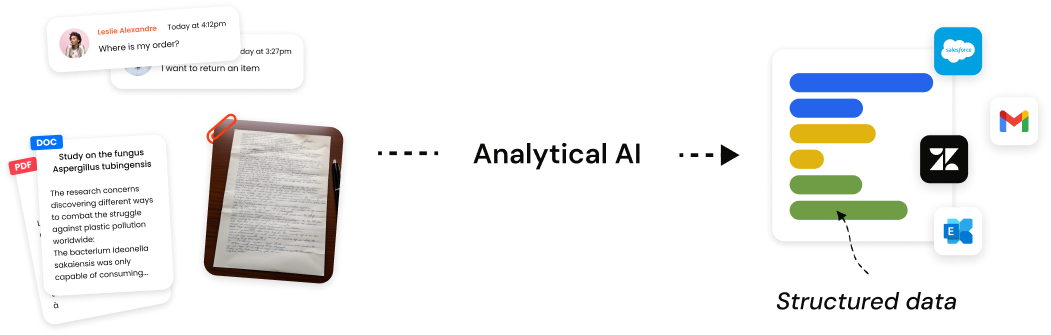
Analytical AI generate structured data from a large volume of both structured and unstructured data.
Categorization, predictions, semantic networks/NLU, extraction, and structuring of information
- Excellent ability to analyze and process large volumes of data, whether structured or unstructured
- Transforms extracted data into the appropriate format for CRM and from the company's existing database.
- Efficient identification of hidden trends and anomalies in large datasets
- Quickly reaches its limits for tasks that involve creativity
- Contextual knowledge rather than general knowledge
Behind these AI systems lie two major approaches: connectionist and symbolic
Generative and Analytical AI are necessarily based on at least one of the two technological approaches below, each offering its own advantages and limitations.
Connectionist AI
The most popular model for generative AI, making predictions and image processing
Statistical AI analyzes large datasets to detect trends and patterns, relying on mathematical and probabilistic techniques.
The name reflects its reliance on statistics and probabilities to process information.
Behind this term lie the following technologies: machine learning, neural networks, deep learning, and more.
- Flexible and adaptable
- Excellent for making predictions based on statistical models
- Applicable in the world of image and audio processing
- It requires a heavy quantity of data for configuration
- Technically, it cannot simply explain its decisions (black box effects)
- Risks of bias
- Difficult to interpret specific business terms
Symbolic AI
The symbolic approach is the most robust and predictable when it comes to analytical AI for language analysis
Symbolic AI relies on the use of symbols and logical rules to model human reasoning.
The name is derived from its method of representing and processing information through symbols.
It is particularly used in expert systems and natural language processing.
- Interpretability: rules and logic are explicit, making decision processes more transparent
- Efficiency in language processing
- Requires minimal data to operate effectively
- Stability and reliability
- Consumes low energy resources
- Complex AI engine design
- Requires explicit knowledge of the context
- Not suitable for all use cases, such as images or audio processing , etc.
Our vision for language understanding: the symbolic-analytical approach
Our technology combines the best of analytical and symbolic methods, delivering a powerful, precise and transparent solution tailored to your specific needs.
Analytical AI (Miralia)
A reduced client investment thanks to a contextual platform configuration carried out on-site by Miralia’s teams (maximum 6 weeks)
Based on interactions and archetypes, fundamental principles for defining meaning in linguistic research
All AI decisions are traceable and demonstrable , allowing for reduced data processing errors and rapid corrections
Faster implementation
Additional reliability rate
Explainable
Generative AI (incl. Machine Learning)
A longer configuration (6 to 9 months) with a significant additional training cost is required to increase accuracy or for each new addition
Based on a complex algorithm that predicts the next word to generate. There is therefore no true understanding , only a probabilistic analysis (risk of errors and hallucinations)
Cannot be explained and demonstrated because it relies on a statistical and probabilistic approach, making its use impossible to use in certain sensitive sectors
Trusted AI
Use a technology free from bias and hallucinations that meets today’s ethical standards.
Efficient
The rapid configuration allows visible results within the first weeks, without semantic complexity or hallucinations
Explainable
All AI-driven decisions are explainable, traceable, and demonstrable.
Sovereign
Miralia’s AI is 100% French, proprietary, and hosted by Scaleway.
Frugal
This technology consumes very little server resources and has a low CO2 impact.
Bring meaning and control
over your customer relationship
Try our explainable, efficient, and reliable AI today.